
Britney Pos, BSDH, RDH, RDA – Clinical Instructor 29 April 2026
Learn why structured training improves outcomes and reduces accreditation risk.
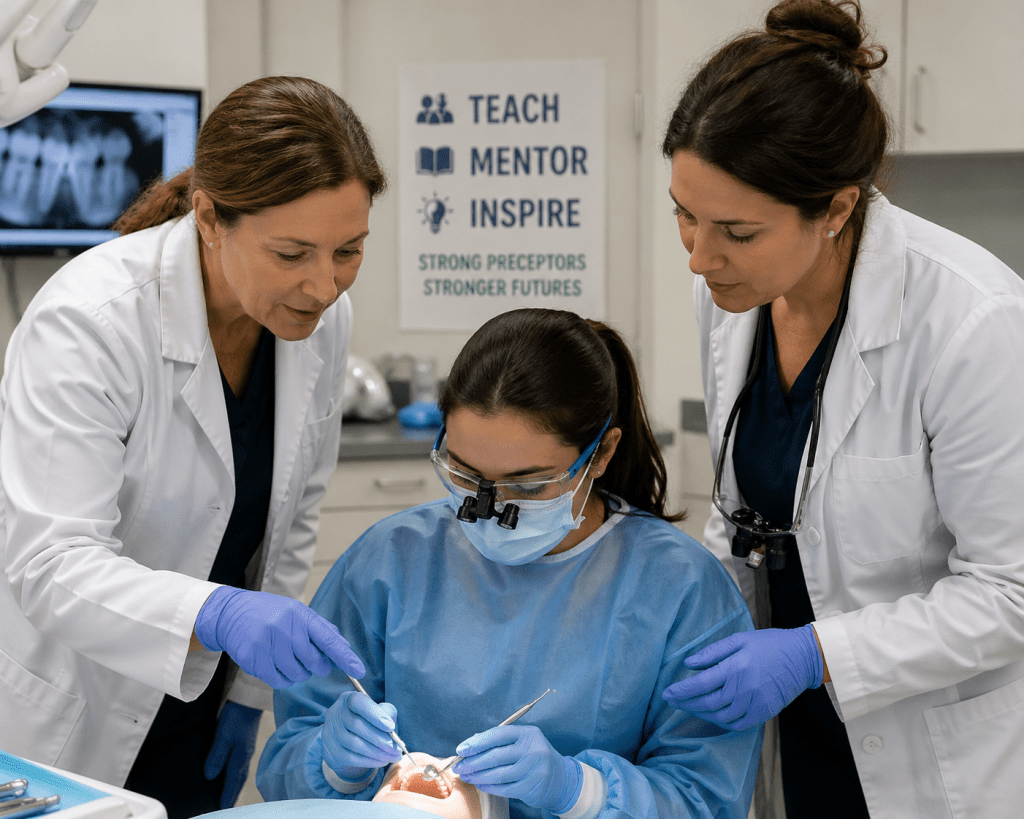
Do you ever wonder how healthcare instructors (AKA: preceptors) get their training? You would be surprised to know that more often than not, clinical instructors are thrown into a role without guidance on HOW to teach the information that they have been trained on. Why does clinic-based instruction not have educational requirements that K-12 Grade teachers do? The answer is simple, as preceptors of a clinic-based healthcare system, we already have the license and clinical expertise to do the job. Obtaining a clinical teaching role ensures that we have a current license in our field: whether it be nursing, dental hygiene, physical therapy or any other preceptorship. Each clinical instructor has proven to multiple boards that they know the required information. In essence we should be able to teach it because we already have the clinical experience, right?
Not quite!
I remember my first day teaching in pre-clinic. My mentor was instructing a junior dental hygiene student on how to properly grasp a Mini 13/14 Gracey. She asked me, “What do you think?” I responded, “I know she is not using the instrument correctly, but I have NO IDEA how to explain the correct way to use it.” The shocking realization I had at that moment was that translating clinical knowledge into a form that you can assess a student’s actions and correct behaviors does not come naturally. It must be taught. Unfortunately, many of us that go into teaching do not always get the mentorship required to learn these skills. Some of us get the opportunity to complete a few hours of peer teaching while we are in school, but these brief moments will not translate ALL of what being a preceptor entails.
Preceptors are selected for one reason: clinical expertise. An excellent clinician must equal an excellent teacher, right? Not necessarily. And that gap is exactly why structured preceptor training in health professions education produces confident, competent graduates.
Clinical Skill Is Not Teaching Skill
A skilled clinician knows how to make decisions under pressure, communicate with patients, and execute procedures with confidence. None of that translates automatically into knowing how to teach a student to do the same. Teaching is its own competency. So is observation. So is feedback. So is the ability to adapt teaching strategies effectively based on individual student’s needs.
When preceptors step into supervisory roles without preparation, programs end up with inconsistent assessment, vague feedback, and clinical evaluations that vary from one faculty to another. For programs in nursing, dental hygiene, physician assistant studies, occupational therapy, and other allied health disciplines, that inconsistency carries real risk. It weakens competency-based assessment, complicates accreditation review, and leaves students unsure and confused.
What a Real Clinical Preceptor Development Program Does
A well-designed clinical preceptor development program goes far beyond orientation. Orientation tells preceptors where to park and which form to fill out. Development of clinical faculty teaches instructors how to observe a learner in action, document specific behaviors, and deliver calibrated feedback that actually drives consistent improvement.
Research on preceptor preparation in allied health settings consistently shows short-term gains in preceptor confidence, teaching skill, and engagement after structured training. One workshop will not solve everything, but ongoing, role-specific preparation produces measurable improvements in how preceptors teach and assess. Those improvements are a core part of what makes a program defensible. Consistent mentorship is key.
Three Areas Most Programs Underinvest In
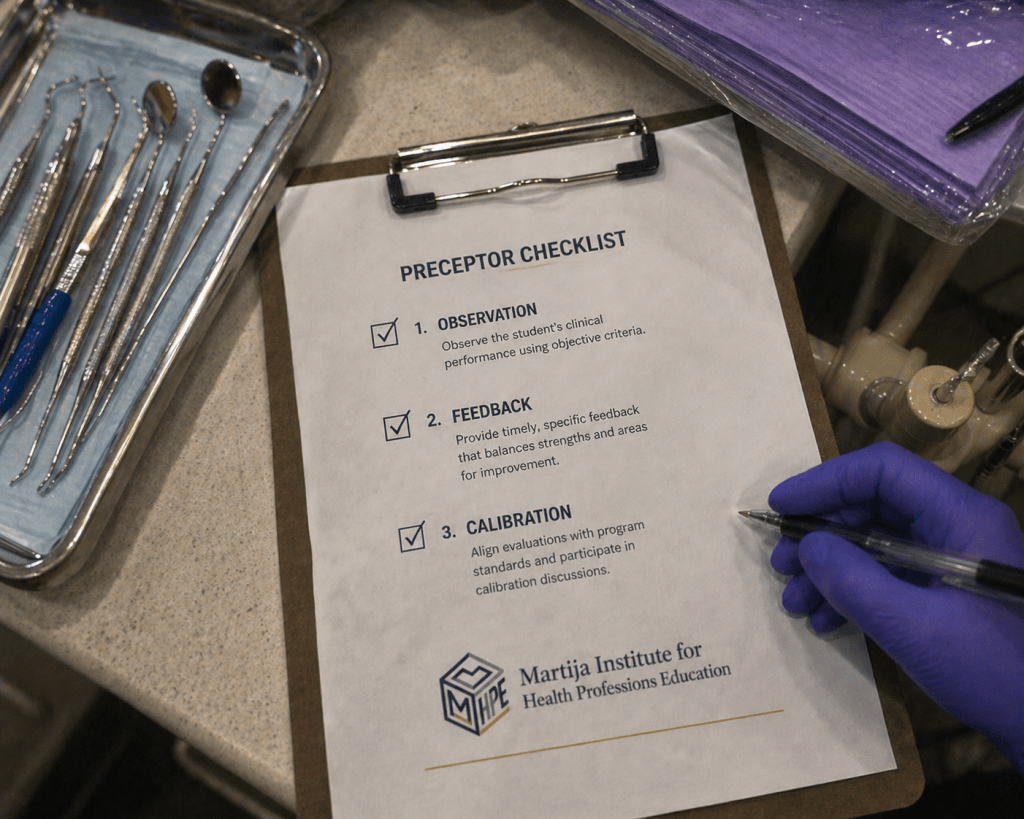
1. Observation skills. Watching a student perform a procedure and translating that into a defensible evaluation is harder than it looks. Preceptors benefit from training in what to look for, how to record it, and how to separate personal clinical preference from program competency standards.
2. Feedback delivery. Effective preceptor feedback training in nursing, dental hygiene, and other clinical disciplines emphasizes timely, specific, behavior-focused feedback rather than generic praise or criticism. This is teachable, and the difference shows up immediately in student performance.
3. Calibration across evaluators. When two preceptors watch the same student and give different scores, the assessment system loses meaning. The students begin to lose confidence in their faculty. Calibration exercises, where preceptors review the same performance and compare their reasoning, are among the most underused tools in clinical education and need to be considered top priority to improve outcomes.
Where Does Accreditation Come Into Play?
Accreditors increasingly want to see how programs prepare and monitor the people doing the evaluating. Documenting preceptor preparation in allied health and clinical disciplines is a necessity. These evaluations must include how faculty are trained, calibration consistency and frequency, and recognize preceptors’ assets and unique clinical experiences that can be used collectively to teach students. Yes, methodology continuing education courses are required, but that alone will not be enough to create a well calibrated teaching structure. Consistent and frequent faculty calibration for preceptors strengthens the program’s accreditation narrative. It also signals that our program treats clinical evaluation as a system. We are not hoping it all works — we have a system of checks and balances that ensures that our students are trained effectively and consistently in all areas of instruction and competencies.
Recognition Keeps Preceptors Engaged
Have you ever worked in a job that you felt like no matter what you did it was never enough? You accomplish the six tasks given to you last week in a timely manner with great effort and in turn you get seven more? No acknowledgement that you have accomplished the previous? Preceptors give significant time to teach. Continuing education credit, formal acknowledgment, and clear pathways to deeper involvement keep us coming back. We all want to be better clinical instructors and we also know that those efforts need to be recognized. This training is imperative for our curriculum vitae and also promotes our desires to stay with a program, thus improving retention.
Building the Infrastructure That Holds the Rest Together
Preceptor development is not a nice-to-have. It is necessary to train our clinical faculty in HOW to teach in order to produce competent and confident clinicians. Let’s no longer strive to “figure it out” at the forefront of preceptorship. Let’s build a foundation of support and knowledge. Without it, even the best-designed program leaks quality at the point where it matters most: the bedside, the chair, the clinic floor. We all strive to be the best clinical instructors that we can be — why don’t we use the tools available to us to better understand our students, our coworkers and ourselves?
If you and/or your program are ready to formalize preceptor preparation, calibration, and recognition, reach out to the Martija Institute of Health Professions Education to talk about where your program is now and where you want it to be.
References
American Association of Nurse Practitioners. (n.d.). Navigating Common Precepting Challenges. Nurse Practitioner Preceptor Knowledge Center. https://assets.aanp.org/psa/ed/navigating_common_precepting_challenges.pdf
Fehrenbacher JE. Dental professionals as clinical educators: A transcendental inquiry into training needs. J Dent Educ. 2025;89:1084–1096. https://doi.org/10.1002/jdd.13782
Griffiths, M., Mills, H., & Sherwood, J. (2022). Systematic review of interventions to enhance preceptors’ role in undergraduate health student clinical education. Nurse Education in Practice, 62, 103349. https://doi.org/10.1016/j.nepr.2022.103349


Leave a Reply