
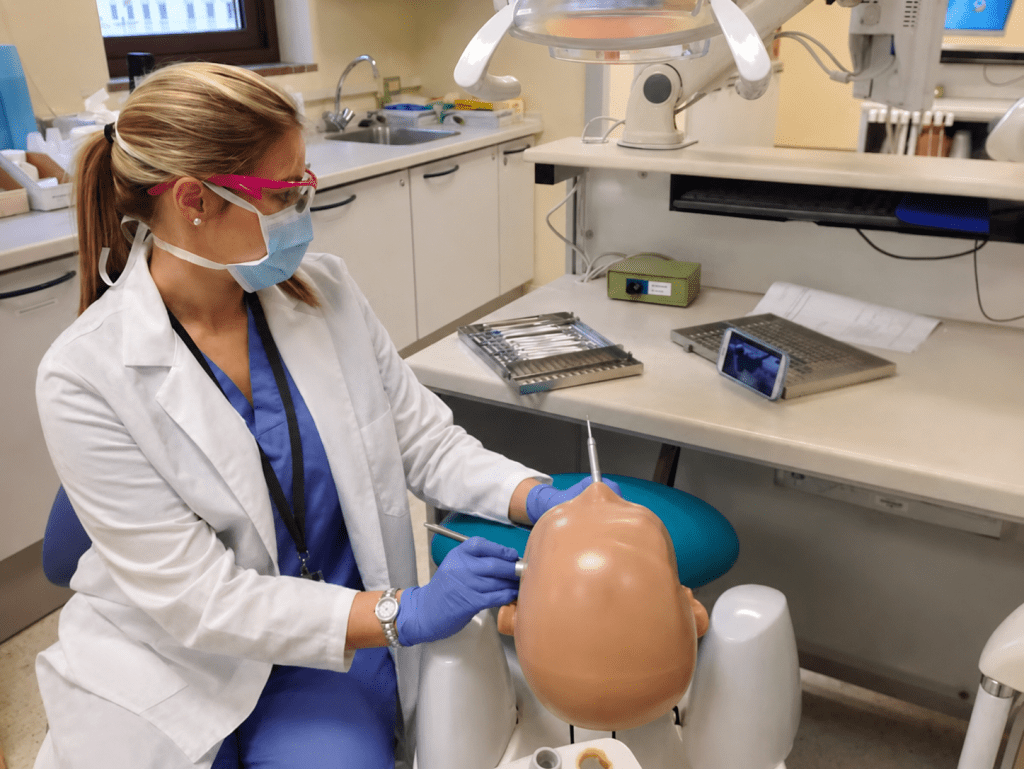
She could answer every question on the exam. So why did she freeze in clinic?
I will never forget one of my students from a few semesters ago. She was brilliant. She sat in the front row, answered questions before anyone else could raise their hand, and consistently scored among the highest in the class on every written exam. Her study guides were color-coded. Her notes were meticulous. If you had asked me to predict who would thrive in clinic, I would have said her name without hesitation, then clinic started.
The confidence she carried in the classroom seemed to dissolve the moment she picked up an instrument. Her hands were shaky. She second-guessed herself constantly. She would look up at me mid-procedure, searching for reassurance that she was doing it right, even when she was. It was not that she lacked the knowledge. She could tell you exactly what she was supposed to do and why. But translating that knowledge into her hands, in real time, with a real patient in the chair, was an entirely different challenge.
If you have taught in a clinical program long enough, you have seen this student. Maybe you have seen them many times. And if you are honest with yourself, you may have even been this student.
So what is actually happening when a high-performing student struggles in clinic? And more importantly, what can we do about it?
The Theory-Practice Gap Is Real, and It Is Well Documented
This phenomenon has a name: the theory-practice gap. It describes the inconsistency between what students learn in the classroom and what they experience in the clinical setting (EL Hussein & Osuji, 2017). It has been studied for decades across health professions, and it remains one of the most persistent challenges in clinical education.
The theory-practice gap is not a reflection of student failure. It is a reflection of the fundamental difference between two types of learning. In the classroom, knowledge is organized, sequential, and controlled. Students are tested on one concept at a time. They can review, pause, and revisit material. In clinic, everything happens simultaneously. The patient is anxious. The instrument is not behaving the way it did on the typodont. The clock is ticking. The instructor is watching. And suddenly, the student who could recite the steps of a procedure flawlessly cannot execute them.
A qualitative study exploring students’ lived experiences during clinical practice found that this gap emerges from multiple sources, including insufficient integration between coursework and clinical placements, limited clinical resources, and the starkly different demands of real-world patient care compared to classroom exercises (Ugwu et al., 2023). These are systemic challenges, not individual shortcomings.
Why Knowing Is Not the Same as Doing
To understand why lecture excellence does not automatically transfer to clinical competence, it helps to look at what is happening cognitively. Cognitive load theory offers a useful framework. It describes the limited capacity of working memory to process new information, and in clinical settings, that capacity is pushed to its limits (Sewell et al., 2019).
Think about what we are asking students to do in clinic. They must recall theoretical knowledge, apply fine motor skills, adapt to a live patient who may be moving or anxious, manage time, communicate professionally, maintain ergonomics, interpret what they are seeing and feeling tactilely, and make decisions in real time. All of this is happening at once. For novice learners who have not yet built the mental shortcuts that experienced clinicians rely on, this simultaneous processing can be overwhelming (Sewell et al., 2019).
Research confirms that workplace-based clinical education imposes high levels of cognitive load that can negatively impact decision-making and learning. Complex tasks, unfamiliar settings, and the demands of the clinical environment all contribute to what researchers call extraneous load, the mental effort spent navigating distractions and logistics rather than focusing on the actual learning task (Sadeghi et al., 2024).
This is why a student can explain a concept perfectly at a desk but struggle to execute it chairside. It is not that the knowledge is missing. It is that the clinical environment demands a type of cognitive processing that the classroom simply does not prepare them for.
Anxiety, Self-Efficacy, and the Confidence Spiral
There is another layer to this that goes beyond cognition: emotion. Clinical performance anxiety is a well-documented barrier for students entering practice settings. A 2025 study published in Scientific Reports found that self-efficacy, social support, and the clinical learning environment all significantly influence the anxiety students experience during clinical rotations (Albaqawi et al., 2025). Students who feel unsupported or who perceive the clinical environment as hostile or intimidating are more likely to experience anxiety that directly interferes with their ability to perform.
What makes this particularly challenging is that anxiety and low confidence feed each other. A student freezes during a procedure. That experience shakes their confidence. The next time they attempt the procedure, they carry that memory with them, which increases their anxiety, which makes them more likely to struggle again. It becomes a cycle that has very little to do with whether they studied hard enough.
This is where our role as educators becomes critical. The learning environment we create, the way we respond to student mistakes, the tone we set in clinic, all of it directly shapes whether students build confidence or lose it.
Academic Grades Tell Part of the Story, Not All of It
It is tempting to assume that strong academic performance predicts strong clinical performance. The relationship exists, but it is weaker than many educators expect. A study of dental students at the University of Jordan found that academic performance could only partially predict practical performance in both pre-clinical and clinical courses. The correlations were statistically significant but weak to moderate, and the researchers noted that other factors, such as manual dexterity and spatial reasoning, play significant roles that academic testing does not capture (Al-Tahaineh et al., 2022).
This is an important finding for anyone involved in clinical education. It tells us that our strongest classroom performers may not be our strongest clinical performers, and that clinical readiness requires a broader set of competencies than what exams measure. It also tells us that students who struggle academically may surprise us in clinic if they bring strong psychomotor skills and adaptability. We should be careful about the assumptions we carry into our clinical evaluations.
Bridging the Gap: What Can We Actually Do?
Knowing that the theory-practice gap exists is one thing. Doing something about it is another. A 2024 systematic review examining barriers and solutions to the theory-practice gap identified several actionable strategies, including stronger collaboration between classroom faculty and clinical preceptors, better alignment between what is taught in lecture and what is practiced in clinic, increased access to simulation, and intentional scaffolding that gradually increases the complexity of clinical tasks as students build competence (Singh et al., 2024).
Simulation, in particular, has shown promise. Research on graduate nurses’ perceptions found that high-fidelity simulation was viewed as an effective strategy for reducing the theory-practice gap, with participants reporting that scenario-based learning helped them feel more prepared for real-world clinical environments (Brown, 2019). Simulation gives students a chance to practice decision-making in a controlled environment, to make mistakes without patient consequences, and to build the automaticity that reduces cognitive load when they transition to live patient care.
But simulation is not the only answer. Some of the most effective strategies are the simplest ones. Talking through procedures out loud before performing them. Pausing mid-task to let students process what they are doing and why. Creating structured moments of reflection after clinical sessions. These small, intentional practices help students connect what they know with what they are doing.
Rethinking How We Think About “Good Students”
If there is one thing I have learned from watching students navigate the transition from classroom to clinic, it is this: we need to broaden our definition of readiness. A student who aces every exam is not necessarily ready for clinic. A student who struggles with written tests is not necessarily unprepared. Readiness is not one thing. It is a combination of knowledge, psychomotor skill, emotional regulation, adaptability, and the confidence to act under pressure.
As educators, we cannot eliminate the theory-practice gap entirely. It is, in many ways, an inherent feature of clinical education. But we can narrow it. We can design our curricula to prepare students not just for what they need to know, but for what they will need to do. We can create learning environments that acknowledge the emotional demands of clinical work and support students through them. And we can be honest with ourselves about whether our assessments truly reflect the competencies our students will need.
The student I described at the beginning of this post? She did not wash out. She did not give up. She grew. It took time, patience, and a lot of encouragement. But by the end of the program, her hands were steady and her confidence was earned, not just from studying, but from doing. That is what clinical education is supposed to look like.
The question is: are we giving every student the support they need to get there?
How do you help your students bridge the gap between lecture and clinic? We would love to hear from you.
Need Some More Ideas? Looking for Educator Support?
Martija IHPE supports health professions education programs in improving how they teach, assess, and develop their faculty, while simultaneously working to expand access to health professions pathways in medically underserved communities.
These two goals are not separate. The institutional relationships we build through consulting create the foundation for community outreach. As we help programs become stronger, we also help connect them to students in communities that have historically lacked access to health professions exposure.
Let’s create something beautiful together. Learn more →
References
Albaqawi, H., Alamri, M., Al-Dossary, R., et al. (2025). Exploring the impact of self-efficacy, social support and learning environment on clinical performance anxiety in student nurses. Scientific Reports, 15, 8663. https://doi.org/10.1038/s41598-025-93400-y
Al-Tahaineh, L., Al-Zubi, I., Al-Tarawneh, A., & Talafha, R. (2022). Predictability of dental students’ performance in clinical courses based on their performance in pre-clinical and academic courses. European Journal of Dental Education, 26(3), 536-542. https://pubmed.ncbi.nlm.nih.gov/34942060/
Brown, J. E. (2019). Graduate nurses’ perception of the effect of simulation on reducing the theory-practice gap. SAGE Open Nursing, 5, 1-9. https://doi.org/10.1177/2377960819896963
EL Hussein, M. T., & Osuji, J. (2017). Bridging the theory-practice dichotomy in nursing: The role of nurse educators. Journal of Nursing Education and Practice, 7(3), 20. https://doi.org/10.5430/jnep.v7n3p20
Sadeghi, A., Alizadeh, M., Rahimi, H., Moghaddam, M. M., & Jafarizadeh, H. (2024). Cognitive load theory in workplace-based learning from the viewpoint of nursing students: Application of a path analysis. BMC Medical Education, 24, 671. https://doi.org/10.1186/s12909-024-05664-z
Sewell, J. L., Maggio, L. A., ten Cate, O., van Gog, T., Young, J. Q., & O’Sullivan, P. S. (2019). Cognitive load theory for training health professionals in the workplace: A BEME review of studies among diverse professions: BEME Guide No. 53. Medical Teacher, 41(3), 256-270. https://doi.org/10.1080/0142159X.2018.1505034
Singh, B. A., et al. (2024). Barriers and solutions to the gap between theory and practice in nursing services: A systematic review of qualitative evidence. Nursing Forum, 2024, 7522900. https://doi.org/10.1155/2024/7522900
Ugwu, S. N., Ogbonnaya, N. P., Chijioke, V. C., & Esievo, J. N. (2023). Causes and effects of theory-practice gap during clinical practice: The lived experiences of baccalaureate nursing students. International Journal of Qualitative Studies on Health and Well-being, 18(1), 2164949. https://doi.org/10.1080/17482631.2023.2164949
 Martija Institute for Health Professions Education
Leave a comment